Introduction
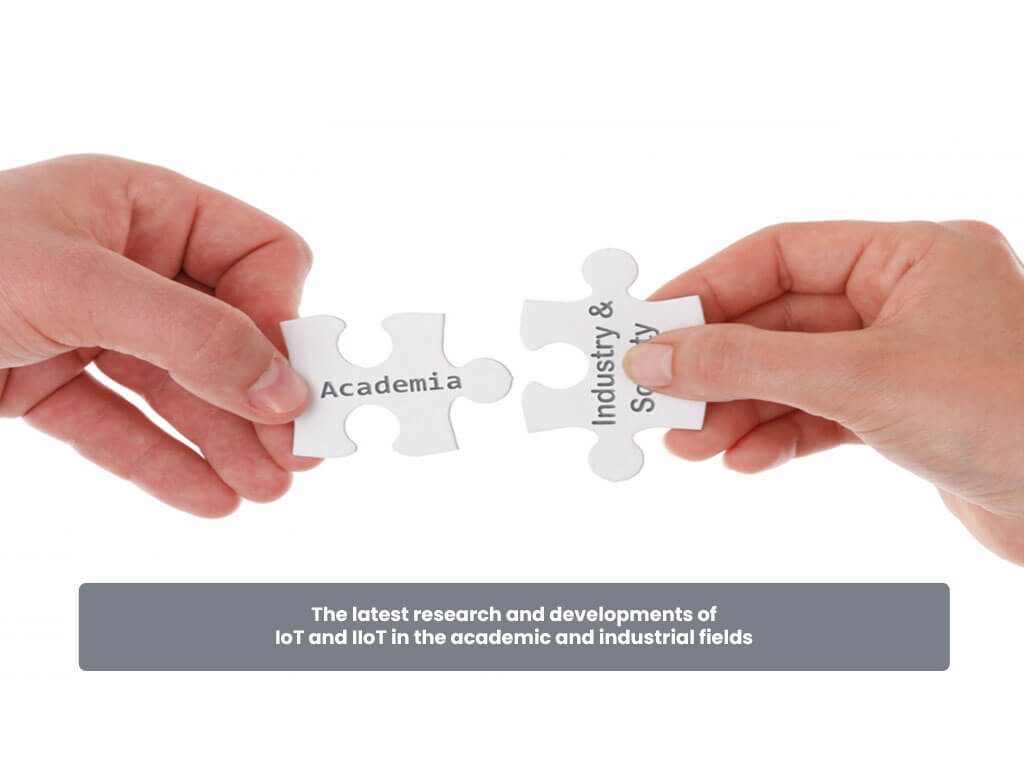
The Internet of Things (IoT) and the Industrial Internet of Things (IIoT) are two of the most transformative technologies of the 21st century. They enable physical objects to communicate, sense, and interact with each other and with computing systems, creating new possibilities for innovation, efficiency, and value creation. In this blog post, we will explore some of the latest research and developments of IoT and IIoT in the academic and industrial fields, and how they are shaping the future of various domains and applications.
IoT and IIoT in academia
Academic research on IoT and IIoT is advancing rapidly, as researchers from different disciplines and domains collaborate to address the challenges and opportunities of these technologies. Some of the current research topics include:
Internet of Robotic Things (IoRT):
This is a new paradigm that combines IoT, robotics, and artificial intelligence (AI) to create intelligent and autonomous robotic things that can communicate, learn, and interact with other things, humans, and the environment¹. IoRT applications can leverage the individual, collaborative, and collective intelligence of robotic things, as well as information from the infrastructure and operating context, to perform tasks more efficiently, productively, and completely. IoRT research covers topics such as intelligent connectivity, architectures, interoperability, trustworthiness, perception, location, communication, cognition, computation, connectivity, propulsion, and integration of federated IoRT and digital platforms¹.
IoT and 5G:
The fifth generation of mobile networks (5G) is expected to provide unprecedented levels of speed, bandwidth, latency, reliability, and security for IoT applications, especially in industrial settings. 5G can enable new horizons for advanced-electronics and industrial companies, such as smart manufacturing, autonomous vehicles, remote healthcare, and immersive entertainment². IoT and 5G research focuses on topics such as network slicing, edge computing, cloud computing, software-defined networking, network function virtualization, and machine learning².
IoT and data analytics:
IoT generates massive amounts of data from various sources and sensors, which can be analyzed to extract valuable insights and enable data-driven decision making. IoT and data analytics research aims to develop methods, models, algorithms, and tools for collecting, processing, storing, managing, and analyzing IoT data, as well as deriving actionable knowledge and intelligence from it. Some of the research challenges include data quality, data integration, data privacy, data security, data visualization, and data governance³.
IoT and IIoT in industry
Industry is one of the main beneficiaries and drivers of IoT and IIoT, as these technologies can improve the performance, productivity, quality, and sustainability of industrial processes, products, and services. Some of the current developments and trends of IoT and IIoT in industry include:
Industry 4.0:
This is the term used to describe the fourth industrial revolution, which is characterized by the integration of digital technologies, such as IoT, IIoT, AI, cloud computing, big data, and robotics, into the industrial sector. Industry 4.0 aims to create smart factories that can optimize their operations, resources, and assets, as well as enhance their flexibility, adaptability, and resilience. Industry 4.0 also enables new business models, such as servitization, mass customization, and digital twins⁴.
Smart labs:
These are laboratories that use IoT to automate and streamline the research and development process, as well as to improve the quality, accuracy, and accessibility of scientific data and experiments. Smart labs can reduce human errors, increase efficiency, save costs, and facilitate collaboration and innovation.
Smart labs can also enable remote monitoring and control, real-time data analysis, and cloud-based data sharing and storage⁵.
R&D outsourcing:
This is the practice of outsourcing some or all of the research and development activities to external partners, such as IoT service providers, consultants, or research institutes. R&D outsourcing can help companies to accelerate their IoT projects, optimize their costs, mitigate their risks, and access specialized expertise and resources. R&D outsourcing can also foster open innovation and co-creation, as well as enhance the scalability and sustainability of IoT solutions.
Conclusion
IoT and IIoT are revolutionizing the academic and industrial fields, as they enable new ways of conducting research and development, as well as creating and delivering value. IoT and IIoT research and development are dynamic and interdisciplinary, as they involve various technologies, domains, and applications. IoT and IIoT research and development are also challenging and rewarding, as they require creativity, collaboration, and innovation. By staying updated on the latest research and developments of IoT and IIoT, we can better understand the potential and impact of these technologies, as well as the opportunities and challenges they present.
References and Resources
(1) Internet of Robotic Things Intelligent Connectivity and Platforms. https://www.frontiersin.org/articles/10.3389/frobt.2020.00104/full.
(2) Internet of Things Insights | McKinsey & Company. https://www.mckinsey.com/featured-insights/internet-of-things/our-insights.
(3) Smart Labs: How IoT is Revolutionizing Research and Development. https://www.iotforall.com/iot-research-development.
(4) The Importance of R&D in IoT | Research & Innovation | hIOTron®. https://www.hiotron.com/rd-in-internet-of-things/.
(5) undefined. https://doi.org/10.3389/frobt.2020.00104.